
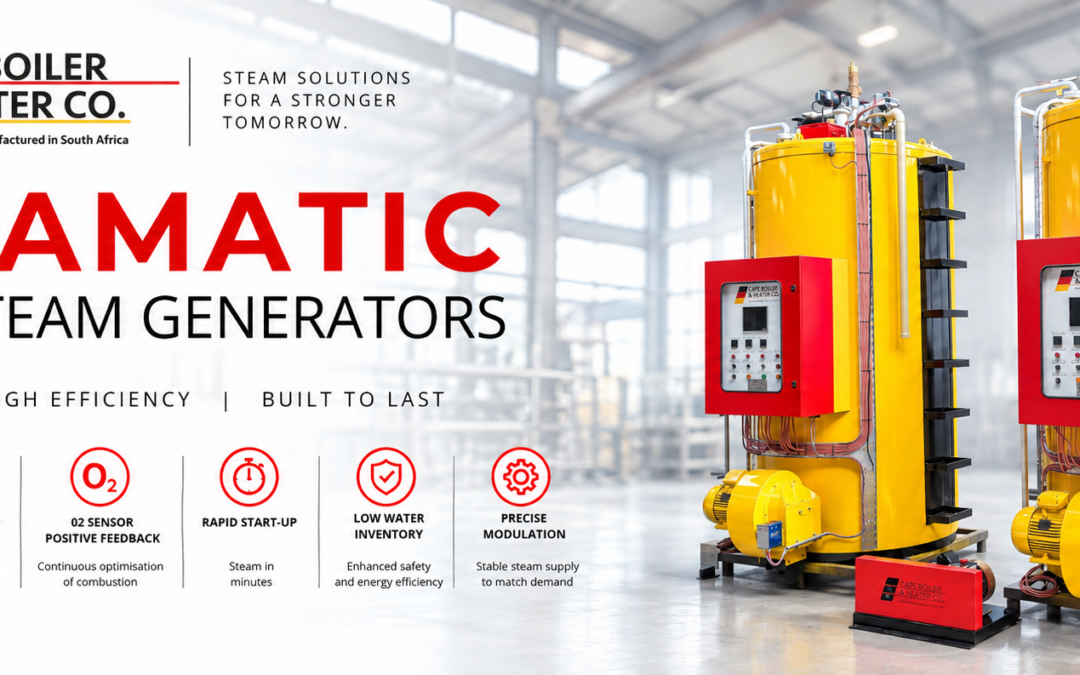
How STEAMATIC and AUTOFLAME Improve Industrial Steam Generation
When specifying an industrial steam boiler, the boiler technology itself is only part of the equation.
The way the boiler responds to changing steam demand, how accurately the burner follows that demand and how effectively combustion is maintained across the firing range can have a significant impact on fuel consumption, operating cost and overall plant performance.
This is where STEAMATIC flash steam generators combined with AUTOFLAME combustion management provide a different approach to industrial steam generation.
STEAMATIC is designed for rapid, responsive steam generation, while AUTOFLAME micro-modulation provides precise control of burner output and combustion. Together, the technologies allow the steam generator to respond to the process rather than simply maintaining a large stored volume of steam and water.
The objective is straightforward:
Produce the steam the process requires, when it requires it, while maintaining controlled and efficient combustion across the operating range.
What Is a STEAMATIC Flash Steam Generator?
A STEAMATIC is a monotube flash steam generator manufactured by Cape Boiler & Heater Co. in South Africa.
Unlike a conventional shell-type steam boiler, a flash steam generator does not rely on maintaining a large volume of stored water inside a pressure vessel.
Instead, feedwater is pumped through a heated monotube coil where heat is transferred rapidly to the water. As the water passes through the heated tube, it reaches the required conditions for steam generation, with the resulting steam separated and delivered to the process.
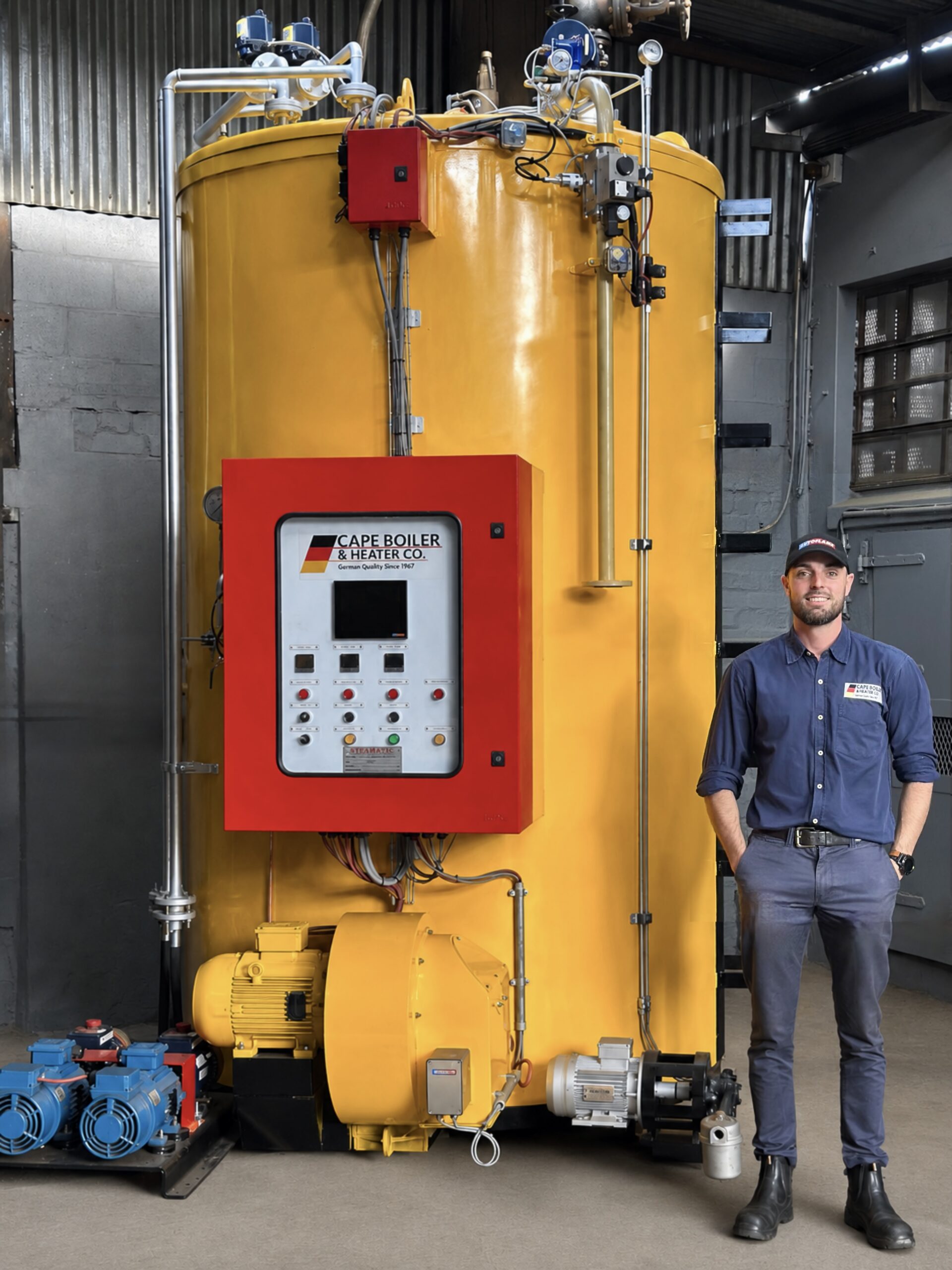
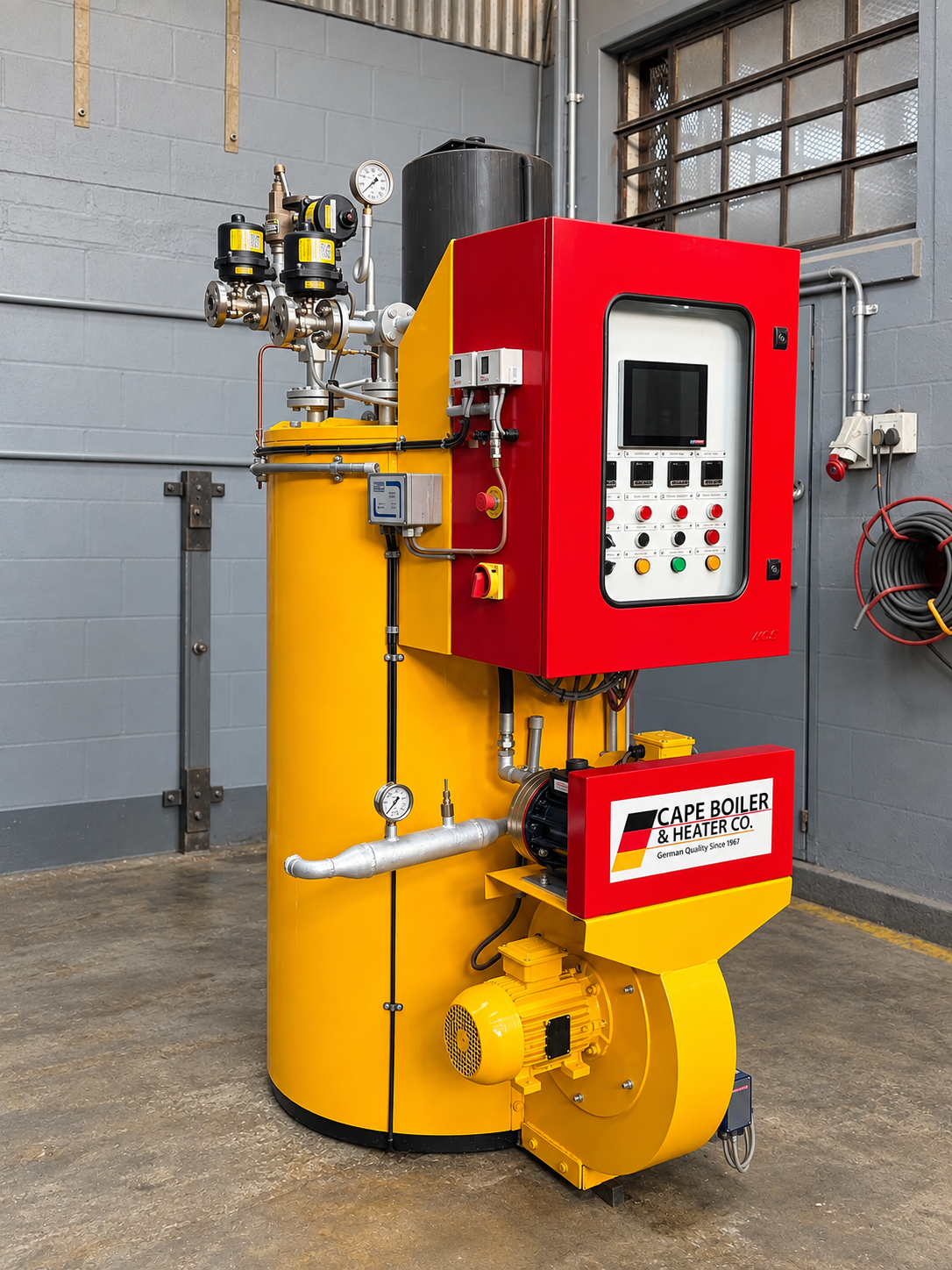
This arrangement provides several important characteristics:
- Rapid steam generation
- Low stored water volume
- Fast response to changes in steam demand
- Compact plant arrangement
- Rapid start-up
- Suitability for variable and intermittent steam loads
- Reduced thermal mass compared with conventional shell boilers
The STEAMATIC range is available in different capacities to suit industrial process applications, with configurations extending into the multi-tonne-per-hour range.
Why Does the Steam Load Profile Matter?
One of the most important considerations when selecting a steam generator is often overlooked:
How does the steam demand actually change during production?
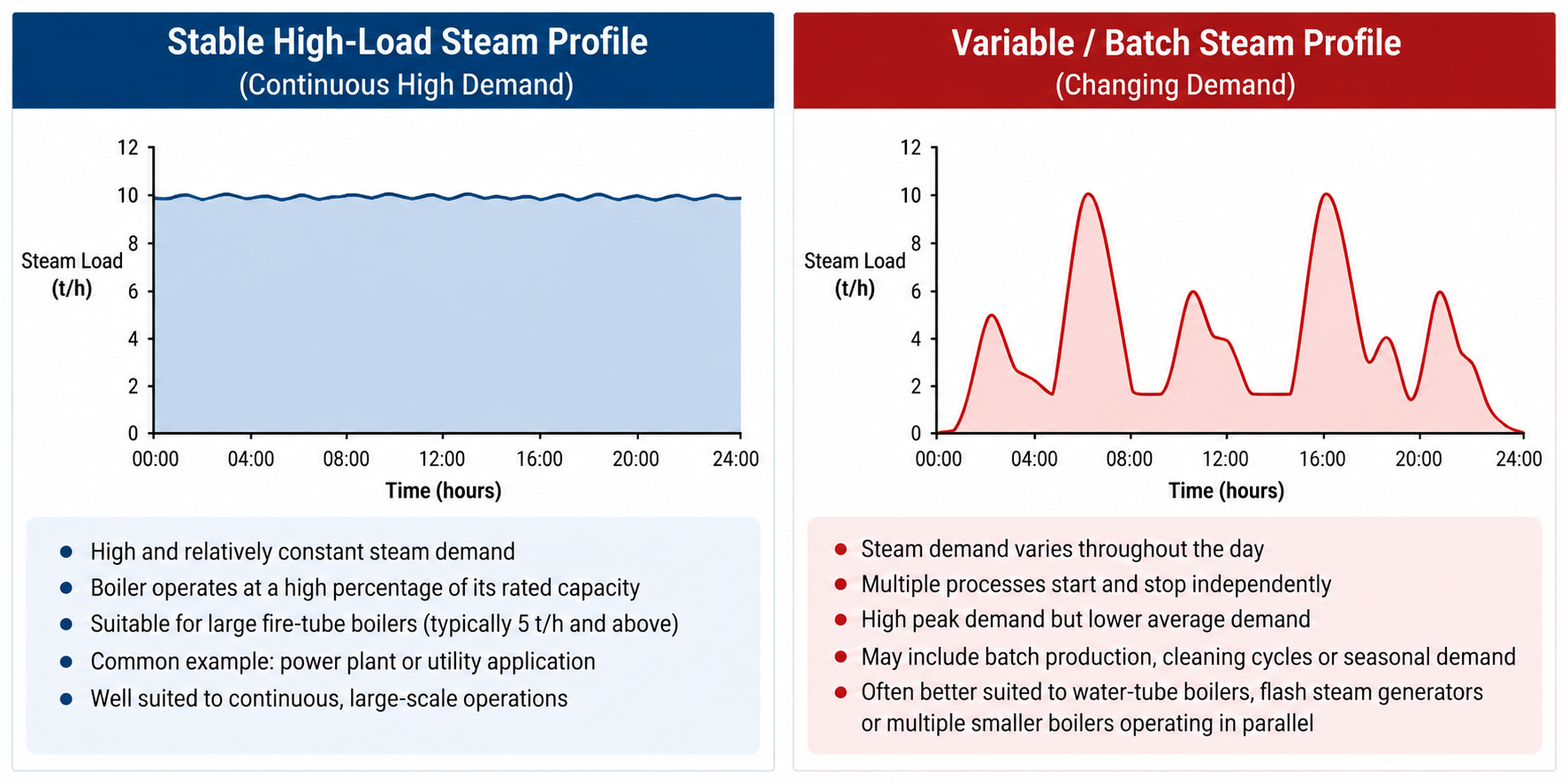
A plant may have a peak steam requirement of 5, 10 or even 20 tonnes per hour. That does not necessarily mean that it requires that amount of steam continuously.
Multiple production processes can start and stop independently. Individual users can modulate their steam consumption. Production batches can begin and end. Cleaning cycles can create short periods of high steam demand.
The result is often a steam demand profile that looks very different from the simple maximum capacity stated on a boiler specification.
Stable High-Load Steam Demand
A conventional fire-tube boiler can be particularly well suited to an application where there is a large and relatively stable steam requirement, allowing the boiler to operate at a substantial percentage of its rated capacity for extended periods.
Variable or Batch Steam Demand
Where the process demand changes continuously or operates in batches, maintaining a large boiler at a high operating temperature and pressure while the process demand fluctuates can create a different operating challenge.
This is where rapid response and accurate load matching become increasingly important.
The maximum steam requirement tells you how much capacity you need.
The load profile helps determine what type of boiler plant you should consider.
How AUTOFLAME Micro-Modulation Changes Boiler Operation
The burner is responsible for converting fuel into the heat required to generate steam.
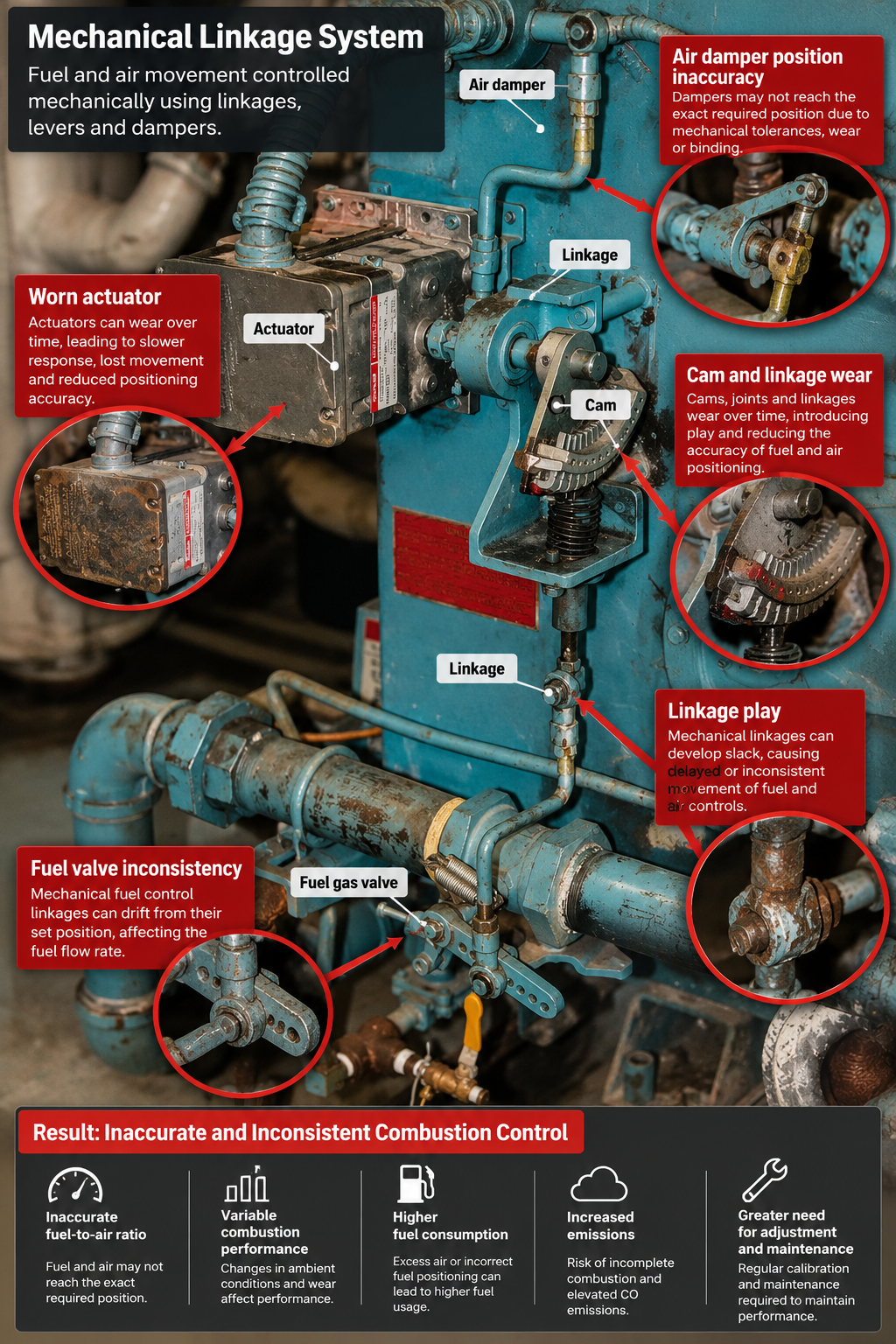
Traditional mechanical linkage systems use physical linkages and dampers to coordinate the movement of fuel and air. Their accuracy can be affected by mechanical tolerances, wear and changes in operating conditions.
AUTOFLAME’s Mini Mk9 is a micro-modulating combustion management system designed for industrial and commercial boiler and burner applications. It uses precise positioning of the combustion control components to regulate burner operation across its firing range.
For a STEAMATIC installation, this means the burner does not simply operate at full output whenever steam is required.
Instead, the firing rate can be continuously adjusted according to the required boiler load.
As the steam demand increases:
Steam demand increases → boiler firing rate increases → fuel and combustion air are adjusted.
As the steam demand falls:
Steam demand falls → firing rate reduces → fuel and combustion air are reduced.
The result is a much closer relationship between the steam being produced and the steam actually required by the process.
The Importance of Maintaining the Correct Air-Fuel Ratio
Burning more fuel does not automatically produce useful additional energy.
Efficient combustion requires the correct relationship between fuel and combustion air.
Too little air can result in incomplete combustion and elevated CO emissions.
Too much excess air carries additional heat out through the flue gas, reducing the amount of useful heat transferred to the boiler.
The optimum combustion condition therefore lies within a relatively narrow operating range.
The challenge is that combustion conditions do not remain perfectly constant.
Fuel pressure can change. Ambient temperature changes. Combustion air density changes. Burner components age. The boiler operates at different firing rates.
A combustion curve established during commissioning therefore does not necessarily remain exactly where it was under every subsequent operating condition.
This is where combustion trim becomes valuable.
AUTOFLAME UV Flame Trim
One of the distinctive technologies available with the AUTOFLAME Mini Mk9 is its patented UV Flame Trim.
The system takes instantaneous readings from the flame itself and communicates this information to the Mini Mk9 for combustion trimming.
This provides an additional layer of combustion management beyond simply positioning the fuel and air controls according to a pre-commissioned curve.
The purpose is to maintain the required combustion characteristics as operating conditions change.
The UV system also forms part of the burner safety and flame supervision architecture.
For an industrial boiler operating across a wide firing range, this additional feedback can help maintain controlled combustion as the firing rate changes.

Positive Feedback from Oxygen Measurement
Where an AUTOFLAME Exhaust Gas Analyser is incorporated into the system, exhaust-gas measurements can provide another layer of closed-loop combustion control.
The EGA measures exhaust-gas parameters and can feed information back to the AUTOFLAME MM controller, allowing the system to adjust the burner fuel-air ratio to maintain the commissioned combustion conditions.
This is particularly useful because the combustion system is no longer relying exclusively on a fixed commissioning curve.
Instead, the control system can observe the combustion result and make appropriate corrections.
In practical terms:
Measure → compare → correct → maintain.
This is the principle behind closed-loop combustion trim.

Important: The exact combustion-control configuration depends on the boiler and burner specification. STEAMATIC plants can be configured with AUTOFLAME micro-modulation and the appropriate combustion monitoring and trim technology for the application.
Combining Rapid Steam Response with Precise Combustion Control
This is where the combination of STEAMATIC and AUTOFLAME becomes particularly interesting.
The STEAMATIC provides rapid response to changing steam demand.
AUTOFLAME controls the burner output and combustion process.
Together, they address two different parts of the same problem:
STEAMATIC
How quickly can the plant respond to the steam requirement?
AUTOFLAME
How accurately and efficiently can the burner provide the required heat?
The result is a steam-generation system designed around load response and fuel efficiency, rather than simply maintaining a large reserve of stored steam and water.
Producing Only the Steam You Need
Industrial steam systems frequently operate below their maximum design capacity.
A boiler rated at 5,000 kg/h may spend much of its operating life producing considerably less than 5,000 kg/h.
If the plant is poorly matched to the process, this can result in unnecessary cycling, inefficient low-load operation or excess fuel consumption.
A responsive flash steam generator combined with accurate burner modulation allows the system to follow the process more closely.
For example:
Low process demand →
low firing rate
Increasing process demand →
increased firing rate
Peak process demand →
maximum required firing rate
As the process demand falls again, the firing rate reduces.
This is the basic principle behind load-following steam generation.
Fuel Efficiency Is a System-Level Question
It is tempting to compare boilers simply by looking at their quoted thermal efficiency.
In practice, the fuel consumption of a steam plant depends on considerably more than the boiler heat-transfer surface.
It is affected by:
- Boiler technology
- Burner efficiency
- Burner turndown
- Load profile
- Combustion control
- Excess air
- Feedwater temperature
- Blowdown
- Operating pressure
- Start-up frequency
- Heat losses
- Fuel quality
- Maintenance condition
This is why a boiler should be evaluated based on its expected operating profile and lifecycle cost, rather than purchase price or nameplate efficiency alone.
A small improvement in combustion efficiency repeated over thousands of operating hours can have a meaningful effect on annual fuel consumption.
The objective is not simply to buy an efficient boiler.
The objective is to operate an efficient steam-generation system.
Is a STEAMATIC the Right Industrial Steam Boiler for Your Process?
There is no universal answer.
The correct steam-generation technology depends on the application.
If your process requires a large, continuous and stable steam load, a conventional fire-tube boiler may be appropriate.
If your process has a variable, intermittent or batch-type steam demand, a STEAMATIC flash steam generator may provide advantages in response time, stored water volume and load matching.
If your existing boiler is operating inefficiently, the answer may also be an upgrade rather than a complete replacement.
Burner replacement, combustion management, oxygen trim, fuel conversion and other improvements can sometimes produce meaningful operating-cost reductions without replacing the pressure vessel.
The important first step is to understand the actual process.
Speak to Cape Boiler & Heater Co. About Your Steam Requirement
Cape Boiler & Heater Co. designs and manufactures STEAMATIC flash steam generators and complete industrial steam plants in South Africa.
We can assess your:
- Required steam capacity
- Operating pressure
- Steam demand profile
- Fuel
- Operating hours
- Existing boiler plant
- Feedwater conditions
- Available space
- Required level of automation
and determine whether a STEAMATIC, conventional industrial boiler or another configuration is appropriate.
Our approach is simple:
Understand the process first. Select the boiler technology second.
If you are planning a new steam plant, replacing an existing boiler or looking for ways to reduce the operating cost of your current steam system, contact Cape Boiler & Heater Co. to discuss the application with our engineering team.
German Quality Manufactured in South Africa.