
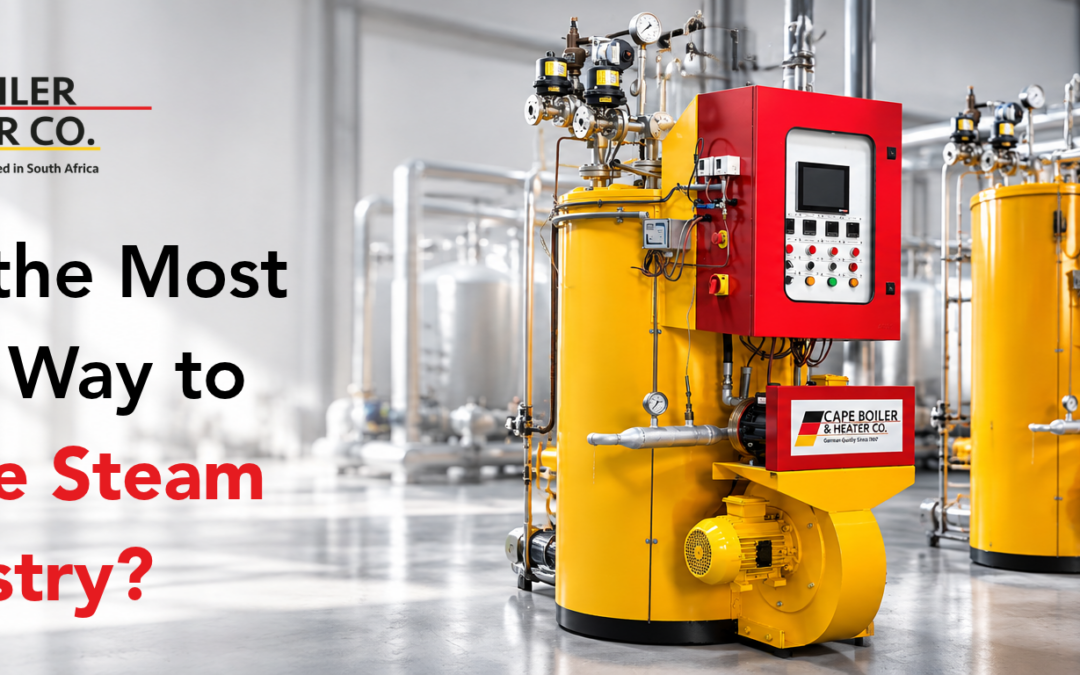
Choosing the right industrial steam boiler is about more than simply selecting a unit with the required tonnes-per-hour capacity. Fuel consumption, turndown, load variation, combustion control, efficiency and lifecycle cost can have a much greater impact on the cost of producing steam.
Generate the steam you need. When you need it. At the efficiency you need.
For growing industrial businesses, steam is not simply a utility. It is an operating cost that affects production capacity, energy consumption, maintenance, water treatment and ultimately the cost of every product manufactured.
That makes the choice of steam generator important.
STEAMATIC Flash Steam Generators from Cape Boiler & Heater Co. combine rapid steam generation with advanced Autoflame Mini Mk9 micro-modulation and UV Trim combustion control, creating a steam system designed to respond to the actual requirements of the process rather than continuously firing at a fixed rate.
The result is a more responsive, compact and intelligent approach to industrial steam generation — particularly suited to businesses in South Africa, Botswana, Namibia, Mauritius and Angola where energy efficiency, reliability and operating cost are increasingly important.
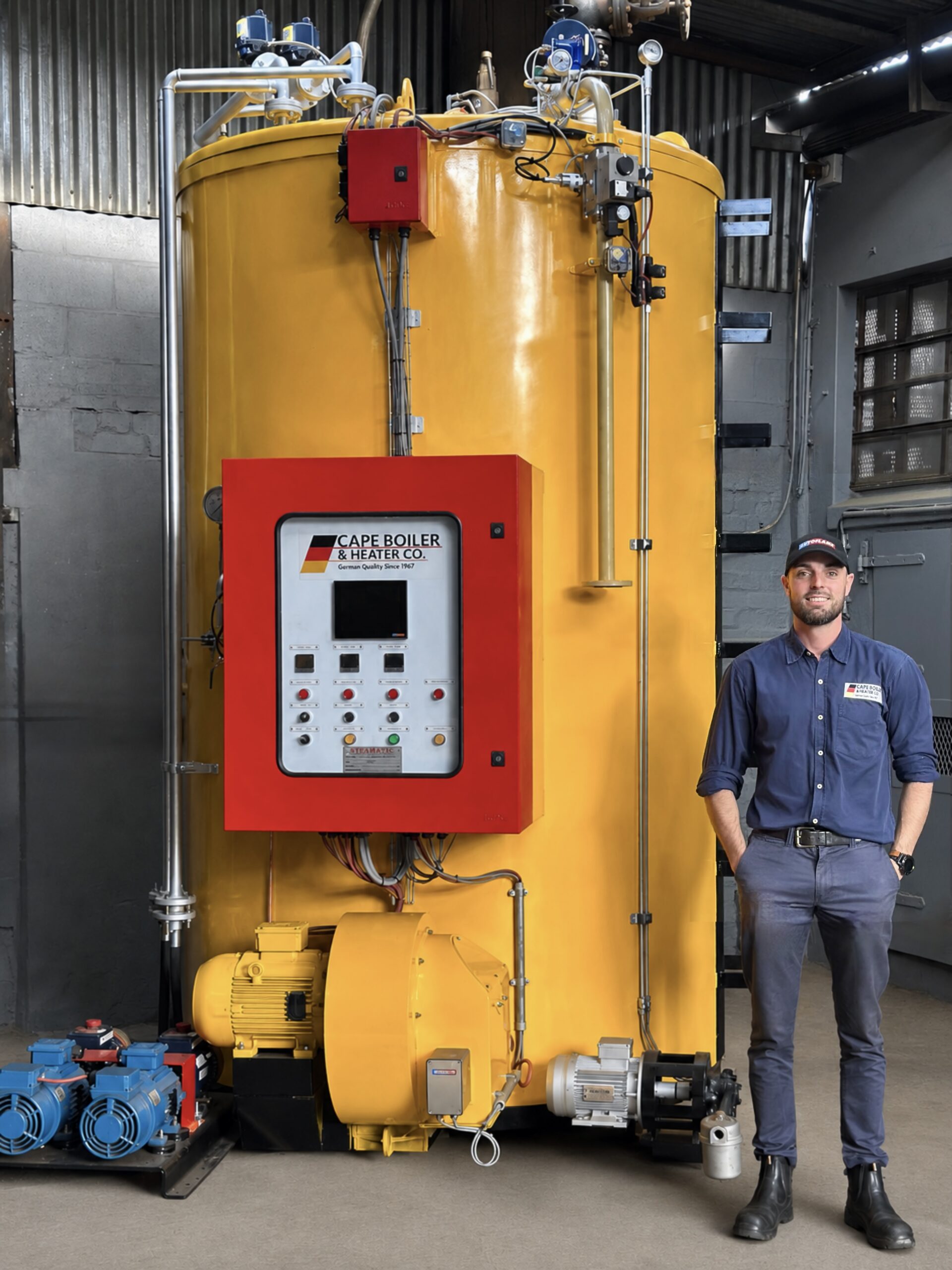
3.5 TPH STEAMATIC Flash Steam Boiler with Autoflame Micro-Modulating Control
Cape Boiler’s STEAMATIC 3.5 TPH flash steam boiler featuring dual-fuel firing (diesel/LPG), Autoflame micro-modulating combustion control, and world-patented UV-based O₂ trim for maximum efficiency and rapid steam generation.
Steam generation should follow the process — not the other way around
Traditional steam boiler systems can spend significant periods maintaining pressure and temperature even when the process is not consuming their full output.
That means energy is being consumed simply to keep the boiler ready.
STEAMATIC takes a different approach.
The flash-steam principle allows steam to be generated rapidly when required, rather than maintaining a large volume of stored boiler water at operating temperature. STEAMATIC units can reach full steam output and operating pressure within minutes of a cold start, allowing the generator to be started much closer to the point at which steam is actually required.
This becomes particularly valuable where steam demand is intermittent, variable or closely linked to production cycles.
You do not need to continuously pay to maintain steam that you are not using.

Micro-Modulation: Matching Steam Output to Real Demand
The next level of efficiency comes from the combustion system.
STEAMATIC systems can be equipped with the Autoflame Mini Mk9 Advanced Micro-Modulation system, which continuously controls the burner to match the required firing rate.
Instead of a conventional stepped approach — for example, high fire, low fire or off — the burner can operate across a continuous modulation curve.
As steam demand increases, firing rate increases.
As demand falls, firing rate falls.
The objective is simple:
Produce the amount of steam the process requires, rather than producing excess steam and wasting energy maintaining it.
The Mini Mk9 provides electronic control of the fuel and combustion air system, with automatic fuel-air ratio management and sophisticated burner sequencing. Its feature set includes continuous fuel-air control, VSD management, fuel-flow metering, setpoint control, scheduling, sequencing and integrated flame-safeguard functions.
This gives STEAMATIC a fundamental advantage: steam generation and combustion control are treated as one integrated system.
Autoflame UV Trim: Continuous Combustion Optimisation
Micro-modulation controls how much heat the burner produces.
The Autoflame UV Trim system helps ensure that the combustion process itself remains optimised as firing conditions change.
The UV Trim Scanner takes instantaneous measurements from the flame and communicates this information to the Mini Mk9, allowing the combustion system to trim the air-fuel relationship during operation. Autoflame describes this as a closed-loop feedback system designed to provide continuous combustion trimming while maintaining safe flame operation.
This is important because the optimum air-fuel ratio is not necessarily identical at every firing rate.
A burner operating at high fire has different combustion conditions from one operating at low fire. Ambient conditions, fuel characteristics, burner conditions and operating conditions can also change.
The control system therefore continuously works to keep combustion where it should be.
The burner does not simply follow a predetermined curve and hope that conditions have remained unchanged.
It continuously manages the combustion process.
Why Micro-Modulation Matters to Your Bottom Line
The value of advanced combustion control is not primarily found on a control panel.
It is found in the fuel bill.
Autoflame states that the Mini Mk9 can reduce fuel consumption by 7–12% compared with traditional linkage systems, while also providing more accurate actuator positioning and integrated combustion management.
Actual savings will depend on the existing boiler, burner, operating profile, fuel, load profile and condition of the installation. However, the engineering principle is straightforward:
Every unit of fuel that does not have to be burned is a permanent operating-cost saving.
For a steam plant operating thousands of hours per year, even a relatively small percentage improvement in fuel utilisation can translate into substantial annual savings.
And unlike a capital project that only creates value at installation, improved combustion efficiency continues to generate savings throughout the operating life of the plant.

Cape Boiler’s THERMAX Thermal Oil Heater – 1150 kW of Fully Modulated Power
1,150 kW industrial boiler equipped with AUTOFLAME combustion management for precise burner control and efficient steam generation.
Rapid Steam Generation + Intelligent Combustion
The real advantage of STEAMATIC is not one individual feature.
It is the combination.
Rapid steam generation
Steam is generated rapidly when required, reducing the need to maintain a large volume of hot boiler water between production cycles.
Continuous micro-modulation
The burner adjusts its firing rate across the operating range to follow changing steam demand.
Advanced fuel-air control
The Autoflame Mini Mk9 electronically manages the relationship between fuel and combustion air rather than relying on conventional mechanical linkage arrangements.
UV Trim feedback
The UV Trim system provides continuous feedback for combustion optimisation as operating conditions change.
Integrated safety
The Mini Mk9 incorporates flame safeguarding, gas-valve proving, pressure monitoring and automated burner management functions.
Connected control
The system supports Modbus and BACnet connectivity, data logging and remote monitoring capabilities for integration into modern BMS and plant-control environments.
Together, these technologies create a steam generator that is designed to respond to the process rather than simply maintain a boiler condition.
Why STEAMATIC Makes Sense for Growing Businesses
A business with a growing steam requirement does not necessarily need a larger conventional boiler.
It needs a steam-generation system that makes economic sense across its actual operating profile.
This is where STEAMATIC can be particularly attractive.
1. Lower energy consumption
If the process does not require maximum steam output, there is little value in continuously firing a large boiler at high output and then dumping or dissipating the excess energy.
Micro-modulation allows the firing rate to follow demand.
Combined with rapid steam generation, this can reduce the energy associated with both steam production and maintaining standby capacity.
2. Better performance at variable loads
Many industrial processes do not consume steam at a constant rate.
- Production starts.
- Production stops.
- Loads increase.
- Loads decrease.
- Different processes operate simultaneously.
A steam generator capable of continuously modulating with the load is better suited to this reality than equipment designed primarily around a fixed operating point.
3. Reduced start-up losses
STEAMATIC’s rapid steam-generation principle means the system does not need to spend long periods heating a large volume of boiler water before useful steam becomes available.
For intermittent operations, this can be particularly valuable.
4. Lower water-treatment burden
Because flash steam generators operate without the same large standing water volume found in conventional shell boilers, STEAMATIC systems can significantly reduce the water-treatment requirements associated with traditional boiler operation.
The exact water-treatment arrangement remains application-dependent and should be engineered according to feedwater quality and operating conditions.
5. Compact, scalable steam generation
STEAMATIC units are available across a range of steam outputs, and multiple units can be combined where greater capacity is required. Cape Boiler & Heater currently lists its STEAMATIC range from approximately 33 kg/h to 5,000 kg/h, subject to model and configuration.
This creates a practical pathway for growing businesses:
Start with the steam capacity you actually require and expand as production grows.
STEAMATIC for South Africa, Botswana, Namibia and Angola
Industrial businesses across Southern Africa face a common challenge:
energy is expensive, and energy efficiency directly affects competitiveness.
Steam is often one of the largest energy consumers in a process plant. Food processing, laundries, abattoirs, chemical manufacturing, mining, pharmaceutical production, packaging, textiles and other industries can all have substantial steam requirements.
For these businesses, selecting a steam generator should therefore involve more than comparing the purchase price of competing boilers.
The correct question is:
What will this steam system cost us to own and operate over the next 10–15 years?
A cheaper boiler can become an expensive boiler if it consumes more fuel, requires more maintenance, takes longer to start, operates inefficiently at low load or requires unnecessary water-treatment infrastructure.
STEAMATIC is engineered around a different proposition:
optimise the entire steam-generation system, not simply the boiler itself.
Why Choose STEAMATIC Instead of a Conventional Boiler?
There is no single boiler technology that is automatically correct for every application.
A conventional fire-tube or water-tube boiler can be the right choice where a process requires substantial continuous steam production and significant steam storage.
But for applications where steam demand is variable, intermittent or relatively moderate, the economics can be very different.
STEAMATIC offers several advantages worth evaluating:
| Requirement | STEAMATIC approach |
|---|---|
| Rapid response | Rapid steam generation |
| Variable steam demand | Continuous burner modulation |
| Fuel efficiency | Advanced electronic fuel-air control |
| Combustion optimisation | Autoflame UV Trim feedback |
| Intermittent production | Start when steam is required |
| Growing demand | Modular/scalable capacity |
| Water treatment | Reduced standing boiler-water volume |
| Automation | Integrated burner management and safety |
| Plant integration | Modbus/BACnet connectivity available |
| Fuel flexibility | Configurations available for applicable liquid and gaseous fuels |
The important point is that STEAMATIC is not simply a smaller boiler.
It is a different approach to producing steam.
Engineered in South Africa. Built for Industry.
Cape Boiler & Heater Co. designs and manufactures STEAMATIC steam-generation systems in South Africa, providing engineering, manufacturing, installation, commissioning, servicing and technical support.
The company has developed STEAMATIC flash steam technology for industrial applications for decades, with current systems incorporating advanced combustion management and automation.
Recent STEAMATIC projects have incorporated Autoflame Mini Mk9 MM, UV Trim, dual-fuel firing, electronic micro-modulation and automated valve sequencing, including fully containerised steam plants manufactured and factory-tested in Cape Town before dispatch.
This means the customer is not simply buying a boiler.
They are buying an engineered steam system.
The Real Question: What Is Your Steam Cost?
If your business is currently operating a conventional steam boiler, it may be worth looking beyond the boiler’s nameplate efficiency.
Look at the entire operating picture:
- How many hours per year is the boiler running?
- What percentage of the time is it operating below maximum load?
- How much fuel is consumed during warm-up?
- How much steam is being generated when the process does not need it?
- How often does the burner cycle?
- How accurately is the air-fuel ratio controlled?
- What happens to combustion efficiency at low fire?
- How much does water treatment cost?
- How much time does the plant spend at operating temperature without production?
- What does the current system cost per tonne of useful steam?
That is the number that matters.
STEAMATIC is designed to attack those operating costs at their source.
Ready to Reduce the Cost of Your Steam?
If you are planning a new steam installation, expanding production or replacing an ageing boiler, do not compare equipment purely on purchase price.
Compare the lifecycle cost of producing useful steam.
Cape Boiler & Heater Co. can assess your existing steam requirement, operating profile and fuel consumption and determine whether a STEAMATIC Flash Steam Generator is technically and economically suitable for your application.
Need more steam without proportionally increasing your energy bill?
Talk to Cape Boiler & Heater Co. about a STEAMATIC system engineered around your actual process load.
Request a Steam System Assessment →
